
Some knights arrive with a name that does the talking for them. Dunk arrives with callused hands, borrowed gear, and the kind of presence that makes people stare before they decide whether to respect him or mock him. “Ser Duncan the Tall” sounds legendary. The reality is much harsher: he’s a working knight trying to hold onto decency in a realm that treats decency like a weakness.
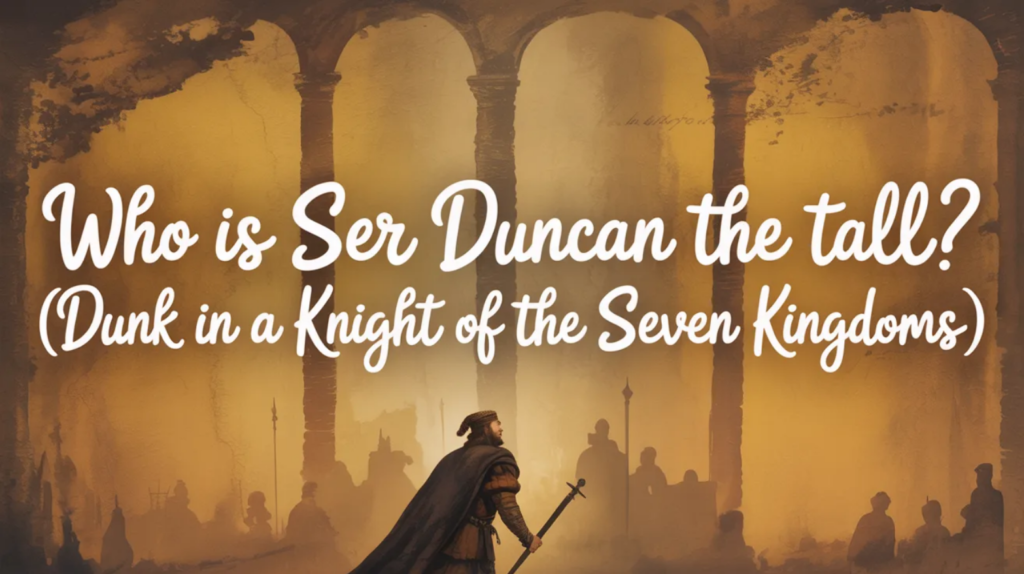
He is the central figure of A Knight of the Seven Kingdoms, but he doesn’t feel like a destined hero. He feels like a man learning the rules as he gets punished for breaking them.
On the surface, he’s just a wandering knight looking for work. Underneath, he becomes a walking test of Westeros itself: what matters more, the title… or what you do when nobody powerful is watching?
Dunk’s background: a knight built from the road up
Dunk doesn’t begin with a noble childhood or a famous family. He grows up rough, learns by watching, and is shaped more by hunger and hard travel than by courtly lessons. That matters because it makes him read the world differently. He notices the little humiliations common people accept every day, and he can’t always pretend they’re normal.
He’s also not the kind of knight who arrives with a household, a reputation, and men to speak for him. Dunk starts from the bottom, which is why “hedge knight” isn’t just a job description in his story, it’s a pressure cooker. If you want the meaning of that life in plain terms, the idea of a hedge knight in Westeros explains why he is constantly one wrong step away from disaster.
Is Ser Duncan the Tall a “real” knight?
Yes, but the tension is that Westeros rarely treats “real” as a simple fact. Dunk’s knighthood is technically legitimate, yet legitimacy isn’t what people respond to first. People respond to signals: the look of your armour, the quality of your horse, the name you can drop, the house that might avenge you.
That’s why Dunk spends so much of the story being judged on perception rather than truth. Even when he does everything “correctly”, the room may still decide he doesn’t belong.
Why Dunk stands out: he takes chivalry personally
Dunk is not witty. He’s not politically sharp. He doesn’t enter scenes with a plan to win them. What he has is a stubborn internal rule: if someone is being crushed, you don’t just watch. That’s the root of his trouble and the reason readers remember him.
In most of Westeros, chivalry is a performance that looks good when it’s cheap. Dunk treats it like a debt you have to pay when it’s expensive. The contrast comes into focus when you look at chivalry in practice, because Dunk’s choices aren’t about reputation first, they’re about whether he can live with himself afterwards.
Dunk and Egg: the partnership that changes both of them
Dunk’s life changes when he takes on a squire who seems too bold, too informed, and too fearless for a stable boy. That boy is Egg, and the story plays a clever game: Dunk is physically imposing, but he’s the one who keeps getting blindsided by the social rules Egg already understands.
Egg is not just “a kid who follows him around”. Egg is a secret that turns every interaction into a risk. When you understand who Egg Targaryen really is, Dunk’s protective instincts take on a different weight, because he’s suddenly responsible for more than his own survival.
What Dunk’s size symbolises
Dunk’s height isn’t just a character trait. It’s part of the story’s machinery. He can’t vanish into the background. He can’t play the harmless nobody. When something goes wrong, eyes swing to him first, because he looks like the kind of man trouble follows.
That’s why the story keeps placing him in situations where strength isn’t enough. Dunk can win a fight, but he can’t punch his way into acceptance. In those moments, his size becomes almost tragic: he’s built like a legend, but he has to live like a drifter.
The Ashford Tourney: where Dunk collides with the system
The Ashford Tourney isn’t important because it’s glamorous. It’s important because it exposes the rules that usually stay hidden. Dunk walks into that world without the social armour other knights carry, and he learns quickly that insults aren’t “just words” when they come from the right mouth.
When you picture the tournament as a place where reputation is currency and pride is law, the Ashford Tourney becomes the moment Dunk stops being a wandering knight and becomes a public problem.
And once pride hardens into something more dangerous, the story escalates into a legal spectacle with blades. The Trial of Seven isn’t just violence for entertainment; it’s Westeros admitting that status disputes are sometimes only “solved” when enough people bleed in the correct order.
Dunk’s shield: a simple symbol with a sharp meaning
Dunk doesn’t carry a famous sigil. He paints one. That seems small until you realise what heraldry means in Westeros: it’s identity, lineage, and permission all rolled into a picture. Dunk is essentially inventing a place for himself in a world that didn’t make one.
The choice is more than decoration. It’s Dunk trying to be seen as something other than “the big hedge knight”. The symbolism behind Dunk’s shield shows how identity in Westeros can be both a weapon and a cage.
Why princes hate Dunk (and why they can’t ignore him)
Dunk is dangerous to certain nobles for a simple reason: he doesn’t behave like someone who knows his place. He isn’t trying to overthrow anyone, but he refuses to accept that cruelty becomes “normal” when it comes from the top.
That refusal is a direct threat to men raised on obedience. It’s why the story keeps circling back to the ugly confidence of rank, something captured in the theme of princely arrogance where power assumes it will be forgiven.
Where Dunk fits in Westeros history
Dunk’s story isn’t “small” just because it follows one man on the road. It happens at a moment where the realm is still haunted by old conflicts and quietly preparing for new ones. The politics are there even when Dunk doesn’t fully understand them, because Westeros always remembers bloodlines and grudges.
If you want the bigger frame, the Dunk and Egg timeline places his journey in the larger history of the Targaryen era, which is exactly why his choices ripple further than he expects.
And when you zoom out, the story becomes a reminder that Westeros runs on promises as much as swords, with alliances that can turn brittle without warning, especially in a world of noble oaths and betrayals that shape outcomes behind closed doors.
Quick FAQs
Why is he called “the Tall”?
Because he’s unusually large even by knightly standards, and people remember him the moment he enters a space. In a society obsessed with image, that makes him both impressive and impossible to overlook.
Is Dunk a good fighter?
He’s strong and capable, but the story doesn’t treat him like a flawless champion. Dunk wins by grit, endurance, and refusal to fold, not by being the most polished knight in the room.
Is Dunk more important than he realises?
Yes. Dunk moves through events that look local at first, but connect to bigger political tensions. Part of the story’s pleasure is watching him stumble into history without trying to become a legend.
Why does Dunk keep getting into trouble?
Because he reacts like a decent man in a system that rewards silence. Dunk can tolerate being poor, but he struggles to tolerate seeing someone else treated as less than human.